Fernández-Pello
SEPTEMBER 10-13, 2024
CARLOS DE AMBERES FOUNDATION CHAPTER 1
Nothing Too Deep
Divided into three parts (Carlos de Amberes Foundation, Río & Meñaka, and Carabanchel), the exhibition follows the author's personal life from his birth and childhood to his current relationship with the two poles of artistic life in Madrid: those represented by the Salamanca and Carabanchel neighborhoods. Two extremes of the city that have been, since Goya's times, reconciled through the problematic ambiguity of art; through their places of exhibition and their places of production; through the difference between the real and the unreal.
Starting with its title, "Nothing Too Deep" poses a riddle –a game– to the viewer. On the one hand, it is a trivial, simple, indirect statement about the nature of art as something superficial, of little relevance, displaying a high degree of social vanity. On the other hand, it is a kind, audacious imperative to fulfill the poetic obligation to delve deeper into the intricacies of something seen as superficial.
Based on that dual premise, an implausible –almost impossible– existential story is constructed, one that is marked by the author’s continued professional lack of definition as a curator, sculptor, professor, translator, designer, economist, consultant, gallerist, and collector, as he does not quite fit into the categories provided by a system of validation that is obsessed with belonging.
Chapter 1. The Court of Cats
“I have never liked cats. I was always afraid of them as a child and eventually discovered that they gave me allergies within half an hour of being around them. Likewise, I've never adapted well to branding systems. Since college, I have tried to ensure that each of the objects I produce has their own character; that I myself am confused by their resemblance or lack thereof to those of other artists, to those of other periods. I have tried to ensure that my works are not my own; that they pick apart the very idea of authorship.
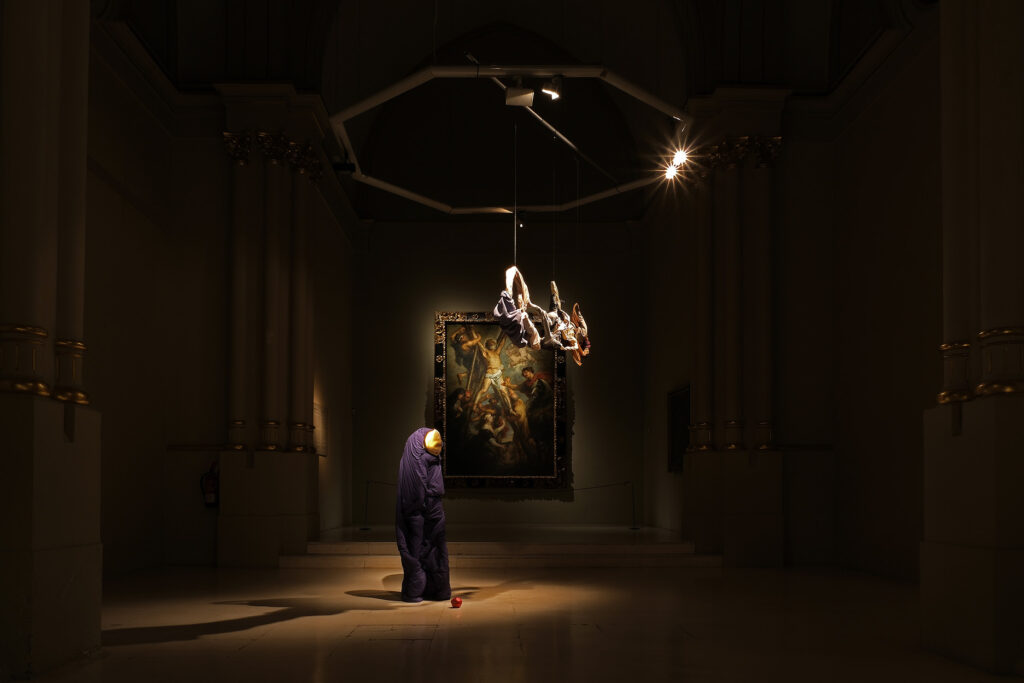
The Carlos de Amberes Foundation was originally called the St. Andrew of the Flemish Royal Deputation, having been created to house and accommodate the poor and pilgrims from the seventeen provinces of the Netherlands.
Today, it houses in its deconsecrated chapel a piece commissioned by Jan van Vucht to the Flemish painter Peter Paul Rubens in 1636, The Martyrdom of St. Andrew – a figure who was crucified, partly, for not worshipping false idols and for preventing himself from material vanities. Paradoxically, more than 380 years later, it still has its original frame.
I remember that at school Cristina used to tease me by telling me that I never had very original ideas; that I only knew how to “copy and improve.” Now that I am approaching forty, I feel I can embrace that condition as my own, as my unique “mark” – the mark of the absence of originality, of race, of heritage. I identify with a wandering street cat, a cat of Madrid’s streets, flowing freely from neighborhood to neighborhood. A loner and drifter with no set nation. The idol of those lacking identity.”