Julia Llerena
Sep 10 - Oct 24, 2026
MADRID
Page 180
IMAGINING A TEXT By Bea Espejo
Imagine a kind of writing so difficult to define that its very name would entail an effort, a conjecture, or a risk, most likely followed by failure. Imagine what it might salvage from disaster, and what it might achieve in terms of form, style, texture, and thought, not to mention feeling. Imagine a multiple book, infinitely fractured, filled with opposing forces, questioning the meaning of writing and the living record of time. The book is blue, quarto-sized, hand-bound in cloth, with the word Dawn written on its cover—something as impossible to grasp as form on shifting sands. Puri began writing it in 1979, a few years before the birth of her daughter Julia, thirty years her junior, with whom she shared an eye for art. The book is a diary full of temporal leaps, notes, intuitions, and thoughts that function as small, unfinished essays. Something like a dialogue with herself, faithful to the fleeting, the scattered, and the ephemeral, in which she tests every potential version of the artist she always aspired to be, including her place within writing. Although numbered through page 300, the text stops at page 180. It was 1994, and Julia was nine years old when illness brought the writing to an end; she was twenty-two when her mother died in 2007.
The diary of Julia Llerena’s mother, kept in the family home since the shock of that loss, now rests on the table in her studio and lends its name to the exhibition Page 180. The point of departure is not new: the artist continues to gather materials from her everyday surroundings, remnants and traces found close to the ground—this time her own ground, Seville—to continue building her characteristic affective archive which, like Puri’s pages, speaks of what is broken and fragile, of the emptiness between things. And, between the lines, of the false appearance of habitability when we are in a state of waiting. The notebook is not merely a book; it is also a mosaic, the equivalent of a labyrinth of loose threads. Far from approaching it as an object of nostalgia through which to linger on the past, for the artist it has to do with the future, with a certain sense of dispersion and coalescence. Nor is the exhibition merely a show; it is a choral dialogue with herself as an artist and a mother, but also as a daughter, somehow repairing and rewriting the pages her own mother was unable to complete, either as a mother or as an artist. It is also a return to painting, the “mother” medium in which Llerena specialised at university, but one she had not revisited for some time.
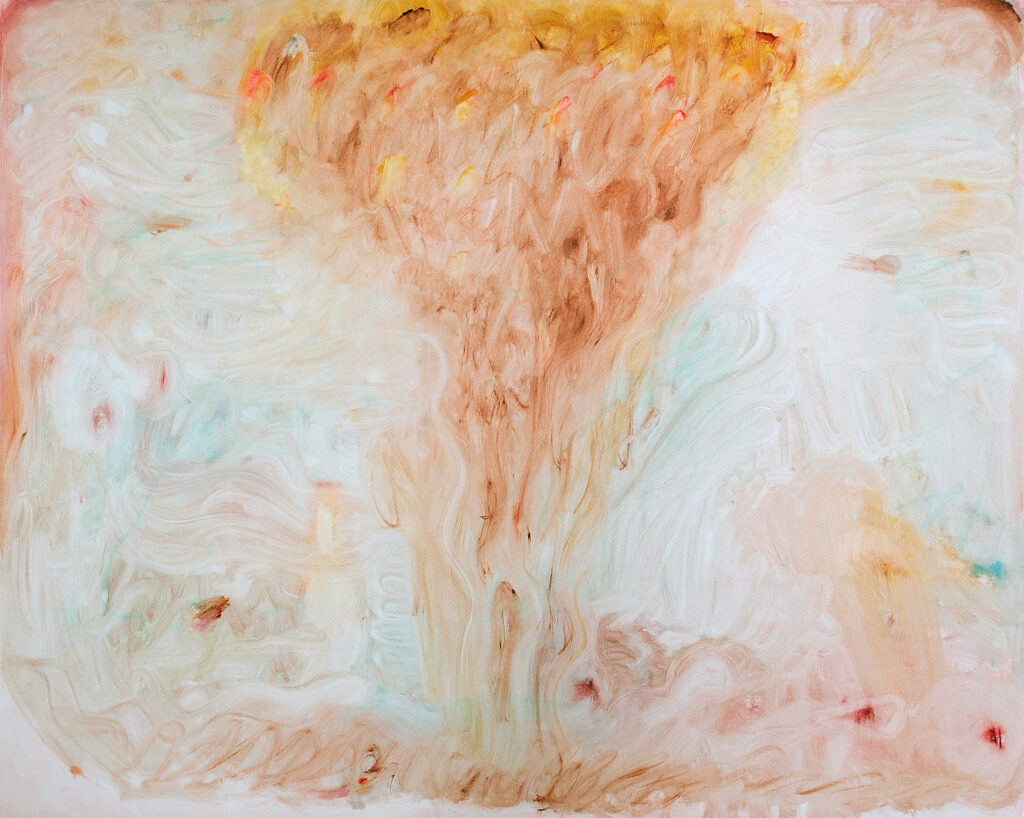
Julia Llerena’s latest paintings are charged with tension, laying bare the physical dimension of the act of writing, the bodily force demanded by painting, and the lessons in survival inherent in any act of caregiving. Each canvas, painted in a single session, like facing a blank page, is a delicate yet intrepid search for painting’s most productive or provocative metaphors: an intimate yet unsparing gesture, direct but full of detours. I think this is also what writing is: that any explanation of the world that fails to draw out its full figurative potential remains somehow incomplete. It is the writing that emerges in the act of writing or, in the artist’s case, the painting that emerges in the act of painting. That is it: the image as a structure of visual thought—or, in other words, the image as open source, as accumulation and reorganisation. This oscillating movement is nothing new in Julia Llerena’s work: the movement back and forth, between distance and proximity, that brings so many of her works together. Here, this duality shifts between creation and caregiving, between motherhood and painting, where the faculty of speech is so often lost. The authors gathered by Moyra Davey in Motherhood and Creation, another book in the library surrounding this project, speak eloquently to this condition.
Within this back and forth, each painting contains multiple encounters and disintegrations. A struggle between image and language, between the conflicts of being a woman and a mother, between holding and being held, between not knowing what to say and saying everything. A direct encounter with materiality in its most classical form—oil on canvas—within an autobiographical process of creation that celebrates the vulnerability of each gesture while reopening wounds that have yet to fully heal. Painting as liberation and critical thought as radical opening. An emotional diary that began some time ago, when Vigo, the second of her children, was barely a year old and the artist would paint gauze in the bathroom with her hands, water, and acrylics, leaving it to dry in the shower before sewing small orphaned objects onto it—orphaned, like her—such as chains, mirrors, and buttons. At times the pieces were stored in boxes; at others they lay piled up in the living room, accompanying the toddler’s first steps. So much information lies veiled there, within those transparencies that conceal more than they reveal.
The paintings in Page 180 operate in a similar way, as memories of an initial gesture that the brush or embroidery activates or interrupts, consistent with Llerena’s understanding of time as something that never moves in a straight line, but rather through overlapping layers. An exercise in pictorial writing that is delicate and inspired, contained like a miniature portrait, like the image of a loved one held within a locket. Paintings that become firm and lucid, developing a gleaming shell that protects them from the outside world, whether real or textual.
The work that closes this emotional diary, this unfinished chapter on emptiness as fertile ground, is Navel, Bowl and Water, which traces a geographical, tactical, and sensory journey through the affinities between skin and clay. The umbilical cord is invoked from the ground, and ceramics through a tracing of clues that allows meaning and memory to emerge from accumulation. The same logic of intertextual accumulation inhabits Dawn, as does the same immeasurable purpose: how to give the appearance of habitability to something that is not habitable.
Page 180 is a project developed in 2026 at Centro de Residencias Artísticas, Matadero Madrid.