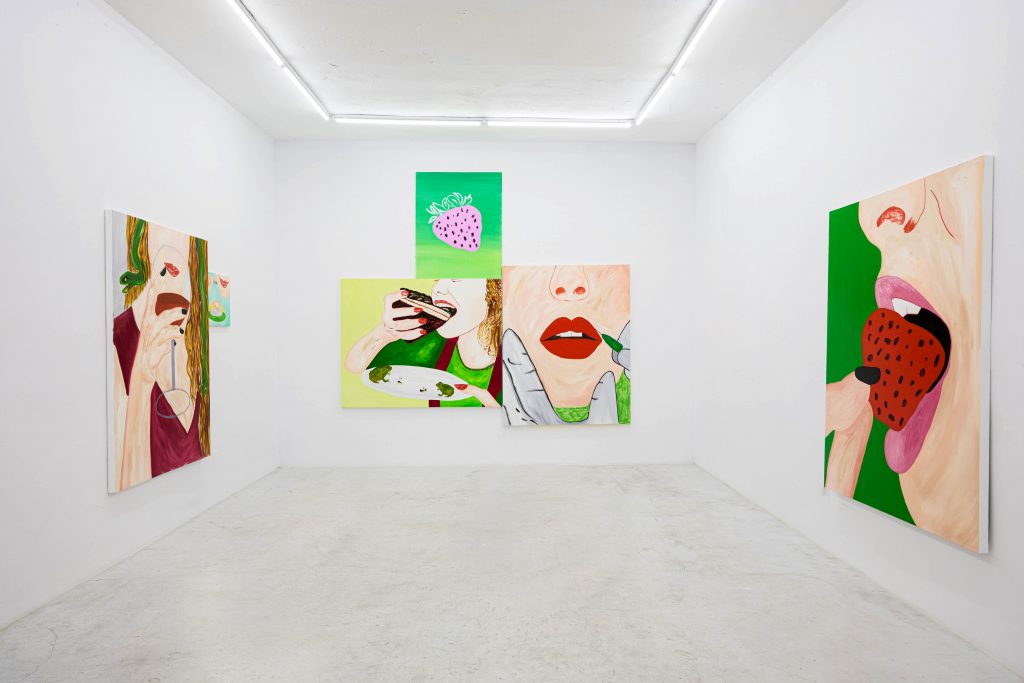
Jazmin Donaldson
16 FEBRUARY 18 MARCH 2023
MADRID
Lo real y lo bizarro
Text: Cristina Anglada
"At night, those enormous, inconsolable, and voracious eyes are devoured by gleaming, inflamed pupils. Their eyes see only appetite. They are eyes ready to devour a world in which they cannot see, anywhere, a reflection of themselves. He passed through the mirror, and since then, he lives as if he were on the other side of things." Angela Carter. (Quemar las Naves. Complete Tales)
The second solo exhibition by Argentine artist Jazmin Donaldson (Buenos Aires, 1985) at the Río & Meñaka gallery brings together a new series of oil paintings in which she continues to experiment with the narrative heritage of folk tales to reflect on social and psychological issues relevant to the modern world.
In early 1994, Marina Warner (novelist, historian, critic, and expert in mythology, symbolism, and fairy tales) delivered the prestigious Reith Lectures for the BBC. In a series of six installments, she addressed current topics by relating them to mythology and fairy tales, such as the fury and terror towards single mothers and non-submissive women in general; the construction of masculinity under ideals of heroism and control; the aftermath of racism expressed in myths about savages and cannibals; or ideas about home or national identity. Through a free and prolific exploration that intertwines the heritage of folk narratives with paintings from art history, films, contemporary books, and video games, she raises sharp criticisms of contemporaneity.
Donaldson shares with Warner a fascination for fairy tales, their various interpretations, their entanglements with folklore and myth, their way of shaping both our moral perception and human behavior, and affecting our imagination. For her, it is interesting to see how one can operate through the narrative strategies of fairy tales to subvert their teachings, especially regarding how it affects the construction of women's identity.
La labor de re-narrar los cuentos tradicionales desde nuevas perspectivas feministas ha sido intensamente afrontada por escritoras como la inglesa Angela Carter, cuyos trabajos acuden a la imaginación, el humor y el poder de las palabras para desatar el tabú sexual y las convenciones de género de los cuentos infantiles. Tanto Carter como Warner realizaron agudas investigaciones recuperando muchos textos que habían quedado enterrados y que plantean miradas y mundos alternativos. En el caso de la antología compilada por Carter, la inclusión de relatos folklóricos provenientes de las más diversas latitudes, desde Siberia a Palestina, pasando por los Apalaches, eran organizados en subgrupos temáticos donde la complejidad del mundo se expandía de múltiples maneras. En su obra Wonder Tales, Warner reúne a su vez una colección mágica de cuentos escritos por mujeres de los siglos XVII y XVIII, apasionados, extraordinarios, con miradas claramente feministas aplicadas a los cuentos clásicos.
The ferocious wolf, Bluebeard, or Hansel and Gretel place insatiable voracity at the center of their tales. In the present exhibition, uncontrolled appetite as a symptom of epochal malaise takes center stage in Donaldson's new works. This is related to the desperate celebration of multiple daily addictions: small or large indulgences that encapsulate various anxieties, fears, and desires of contemporaneity, fueled by continuous exposure to shaping identity through the virtuality of social media. The insatiably aroused desire for capitalist lifestyle, based on production and consumption, highlights the discomfort derived from a sick system, in which we survive in part thanks to stimulants and antidepressants.
Each scene arises from a mixture of autobiographical experiences and observations of everyday life intertwined with recognizable symbolism derived from myths and folk tales, through which ideas about identity and social status (shoes, boots), sexual appetite (fruit), indulgence (cakes), power or wickedness (snake), masculinity and abundance (rooster), etc., unfold.
Donaldson employs humor and the strategy of absurdity in a post-pop style with a surrealistic bias that brings her closer to the intentions of painters like Katherine Berhnhard, Jill Mulleady, or Nina Chanel Abney. She explores how to use the narrative tools she learned studying film direction in painting. Each painting stands as a frame from which to launch clues to the viewer so they can imaginatively trigger the rest of the scenes. The composition's structure poses a narrative use of space and time, using color to suggest moods or symbolic associations.