Alfonso Albacete
15 March 29 April 2019
Madrid
Zénzanne
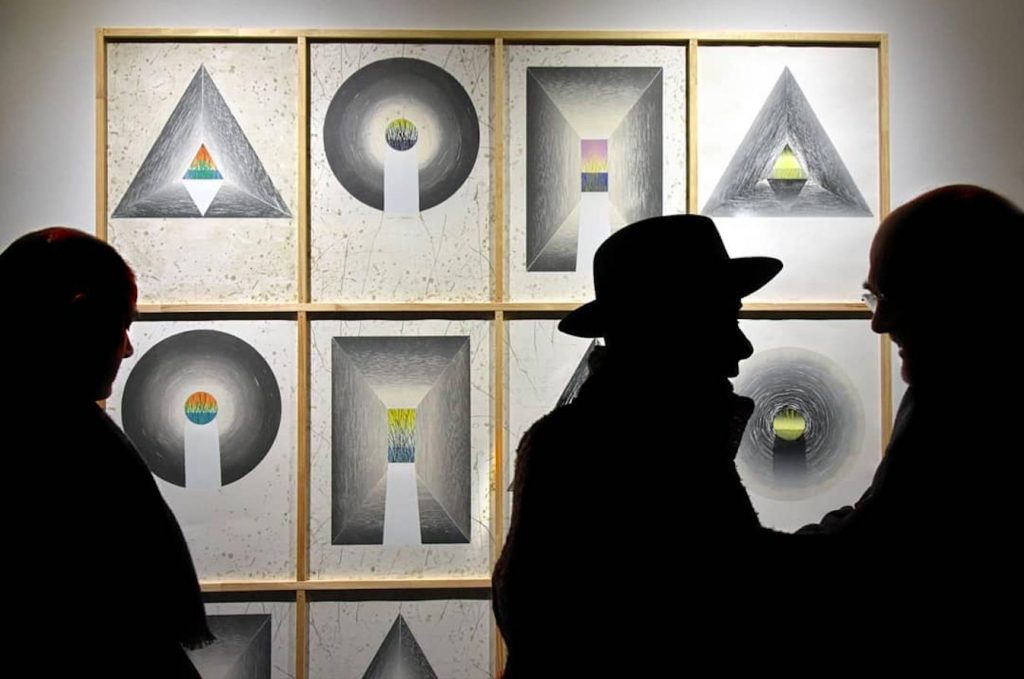
On a visit years ago to the samurai castle of Himenji in Japan, Alfonso Albacete (Málaga, 1950) was struck by the shape of the embrasures— the holes in the wall to monitor or shoot at the enemy— which consisted of a line of figures alternating triangles, circles and squares as in a geometric series. “This immediately reminded me of Cézanne's proposal in which we could see nature as a set of cones, cylinders and spheres and that its projection on a plane in the form of triangles, squares and circles was ideal to represent any existing model” , comments the artist.
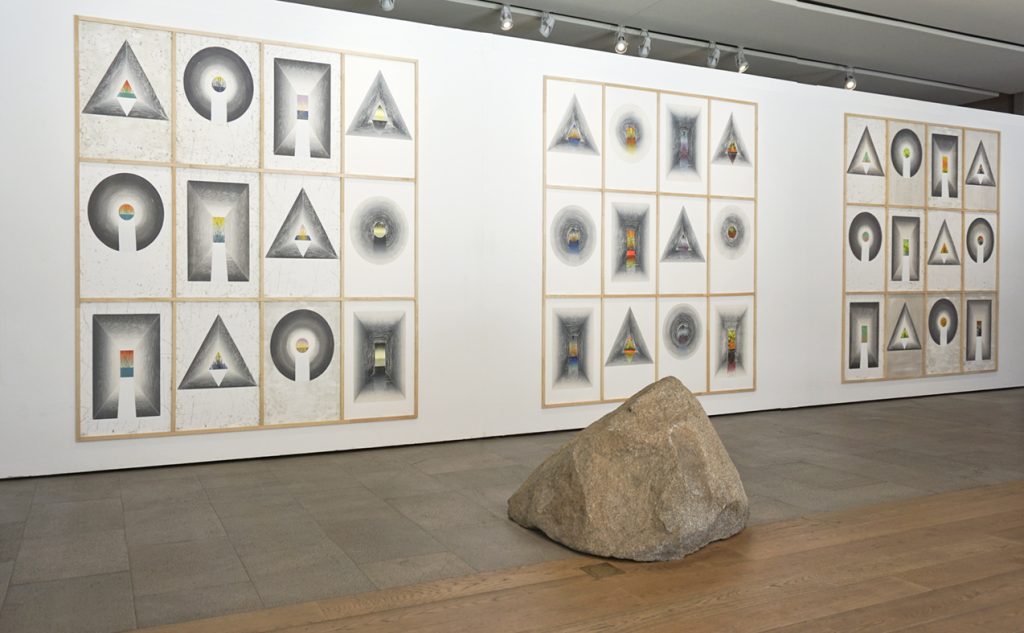
From this trip was born “Zénzanne”, the latest individual exhibition by the Malaga painter Alfonso Albacete, which can be seen from March 15 to April 29 at Río & Meñaka Madrid, where he shows a collection of graphic work made in close collaboration with the publisher Ogami. Press, which takes as its starting point one of Paul Cézanne's most famous pictorial theories: “Everything in nature is modeled after the sphere, the cone or the cylinder.” According to the French painter, “you have to learn to paint based on these simple figures, then you can do anything you want.”
Starting from these three simple shapes, Albacete builds a research project on light and landscape in which through your gaze you can observe how color and shape modify perspective. The different varieties of graphic techniques used are displayed in a series of pieces that are both serial and unique. The result is an open set of 39 unique pieces made with etching on copper, woodcut, silkscreen and monotype on paper. The theme of exoticism and specifically the Japanese garden is a recurring theme in the artistic career of Alfonso Albacete. Both in his pictorial work and in his work on paper, Albacete displays the sensitivity, vividness and composition so characteristic of this landscape construction so loaded with symbolism such as the Japanese garden.
The exhibition is completed with canvases and drawings by the author, never seen before, about the Zen garden and nature, “a set of geometries that these Buddhist samurai organized with a completely opposite intention, that of stopping time, since its components , gravel, moss and rocks, by not offering us any apparent changes, one can think that contemplating them is freeing us from the anguish of the passage of time."
Alfonso Albacete (Antequera, Málaga, 1950) trained as a painter with Juan Bonafé in La Alberca (Murcia), later carrying out his studies in Fine Arts and Architecture in Valencia and Madrid. Later he received a scholarship from the Ministry of Culture to investigate new expressive forms. In the seventies he returned to painting and held his first individual exhibition at the Chys Gallery in Murcia in 1972.
With a dense and prolific career, among his individual and group exhibitions, it is worth highlighting those held: at the Centro Andaluz de Arte Contemporáneo, Seville (2014); at the Reina Sofía National Art Center Museum, Palacio de Velázquez, Madrid (2014); at the Marlborough Gallery Madrid (2014); in the ACB Collection. Villa Iris, Santander (2012); at the Marlborough Gallery Barcelona (2011); at the Museum of Modern Art in Moscow, Russia (2011); in the Monastery of Veruela, Zaragoza (2011); at the Marlborough Gallery Madrid (2011); in the Contemporary Art Collection at the MEIAC, Badajoz (2007); in the Sala Verónicas, Murcia (2006); at the Espacio Caja de Burgos, Burgos (2000) at the Círculo de Bellas Artes, Madrid (1999); at the Art Basel 17'86 fair (1986) and at the Chicago International Art Exposition, Chicago (1987).
Likewise, he is present in numerous collections such as the Andalusian Center of Contemporary Art, Seville; at the Museum of Abstract Art, Cuenca; at the Official Credit Institute, Madrid; in the Museum of Fine Arts, Murcia; at The Chase Manhattan Bank, New York, USA; in the Municipal Museum, Madrid; in the Banca Lambert Collection, Brussels, Belgium; in the White House Collection, Washington, USA; at the “La Caixa” Foundation, Barcelona; at the Collection Dobe, Zurich, Switzerland; at the National Telephone Company of Spain, Madrid; at the Banco Exterior de España, Madrid; in the Provincial Museum of Álava, Vitoria; at the Bilbao Fine Arts Museum, Bilbao; at the Mie Prefectural Art Museum, Mie, Japan; in the Contemporary Art Collection, Madrid; at the CAAM, Atlantic Center of Modern Art, Las Palmas de Gran Canaria; at the Wurth Museum, Kunzelsau, Germany; at the Museo Nacional Centro de Arte Reina Sofía, Madrid; in the Patio Herreriano Museum, Valladolid; in the AENA Foundation Collection; in the Helga de Alvear Collection, Madrid and in the Olor Visual Collection, Barcelona.