ARCO Lisboa 2025
29 MAY - 1 JUN, 2025
LISBON, PORTUGAL
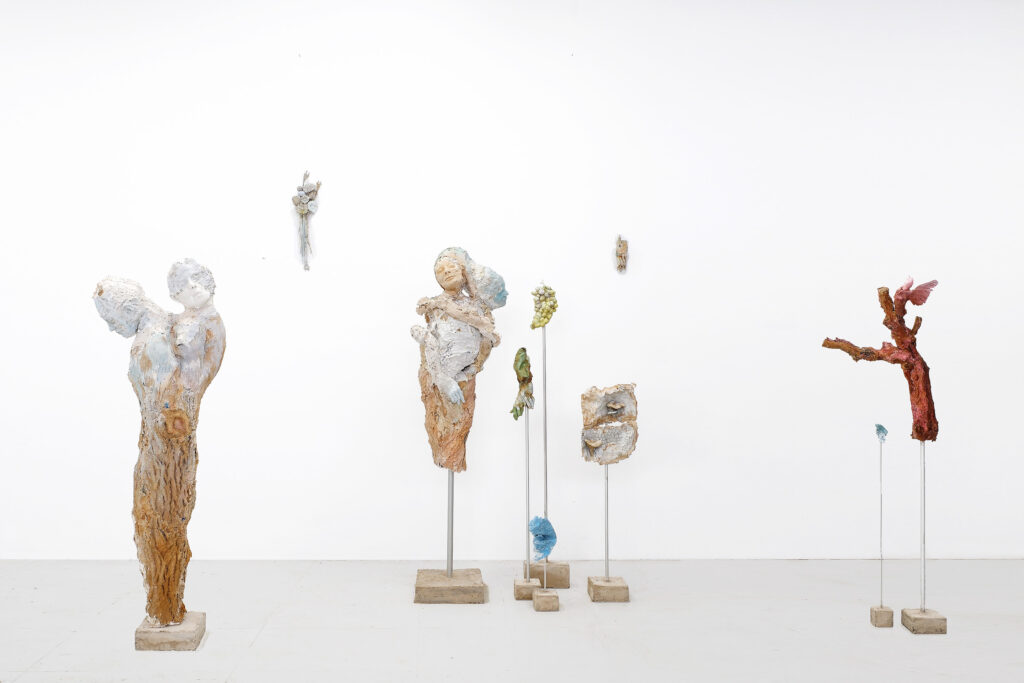
RÍO & MEÑAKA is pleased to announce its participation in the ARCO Lisboa 2025 fair with a solo show by French artist Margaux Compte-Mergier (Paris, 1994). In her work, she questions our projections towards the future, the presence of catastrophes in our imaginations, and the aesthetics of digital errors. Through motifs inspired by everyday life, animals, and the human body, she creates universes imbued with a sense of the "uncannily familiar".
In her sculptures, as in any landscape—even a metaphorical one—what is near and what is distant converge, dimensional relationships create reliefs, and each sculpture delicately layers details and fragments. A severed arm like a branch bending under the force of a strong wind; a single torso; a widowed foot; a navel taking on the appearance of a wine glass; faces fused into two heads reminiscent of old carnival attractions. The whole body strongly displays an evident deconstruction. A total and almost grotesque frenzy of an anatomy that is familiar yet strange. Reality is contorted everywhere by fictions. And by frictions, since these sculptures abound with exogenous elements such as computer parts, tree bark, cleaning gloves, etc. A fortuitous exploration of the manipulation of mediums and DNA: the sculptures evoke the ever-shifting versatility between humans and objects, the symbiosis of entities welding simple trash to human organs. From these cuttings, one could evoke fairy tales, science fiction films, or even the unlikely definition of the increasingly complex word (and concept) of life.
The artist draws on references ranging from ancient statues to the elastic bodies of Eva Hesse, as well as the polysemic nature of Bruce Nauman. A sculpture of remnants and of high vertigo.
Her most recent works revolve around the concept of the “bestiary,” a medieval manuscript that compiles stories and moral lessons about animals, real or imaginary, described as religious or ethical symbols. These texts offer more than knowledge about animals: they reflect, through their descriptions, how humans perceive their beliefs. In this way, Compte-Mergier creates sculptures that play with an animal element. They evoke the fragility of the beast, the risk of its disappearance, transhumanism, and question the evolutionary notion of “life” and the boundary between nature and culture.
Her works are situated in a moment of transition, in an intermediate state. An interval before the “after” manifests. Between a before and an after that reflect one another, leaving the present suspended. Through this, Compte-Mergier questions the time in which we live—a time in which our representation of the future imposes itself as an unresolved and anxiety-laden question: a flow, a heterogeneous matter in continuous transformation, composed of images of catastrophes, disasters, climate crises, wars, and the end of times. It is on this anxiety of what is to come that the artist focuses.
The sculptures have been captured in their becoming. They are frozen in a transitional state, a moment of uncertainty where elements blend and intertwine. Animals, the human body, plants, and objects mutate without us knowing in which direction. Hybrid creatures of a suspended time… They are beautiful, unsettling, playful, nightmarish. These marvellous monsters evoke science fiction, religious scenes, mythological representations, Ovidian metamorphoses, and, more broadly, question the notion of the sacred.
The creative gesture is positioned in the “before”, tending toward what is yet to come. When the artist begins working, she does not know the final fate of the pieces. In the works, there remain indicative marks of the present moment of their creation—feathers, pieces of paper, branches… trapped in the material—that will remain forever frozen. The material itself is in constant flux. Compte-Mergier works with a natural resin and with powders of various metals that continue to evolve over time (copper turns bluish, iron oxidises and changes colour, bronze turns greenish). These sculptures invite two types of gaze: the contemplative gaze, which embraces the landscape in its entirety and understands its general form; and the detailed gaze, which deconstructs the unity and imposes careful attention to each of its parts.