Nuria Mora
18 FEBRUARY 3 APRIL 2020
MADRID
Lalita Banana Split
Nuria Mora, one of the main representatives of urban and geometric art in Spain, opens at Río & Meñaka Madrid "Lalita Banana Split", her most intimate and autobiographical exhibition, a tribute to her family and a heartfelt homage to her grandmother Lalita, who passed away last spring at the age of 101.
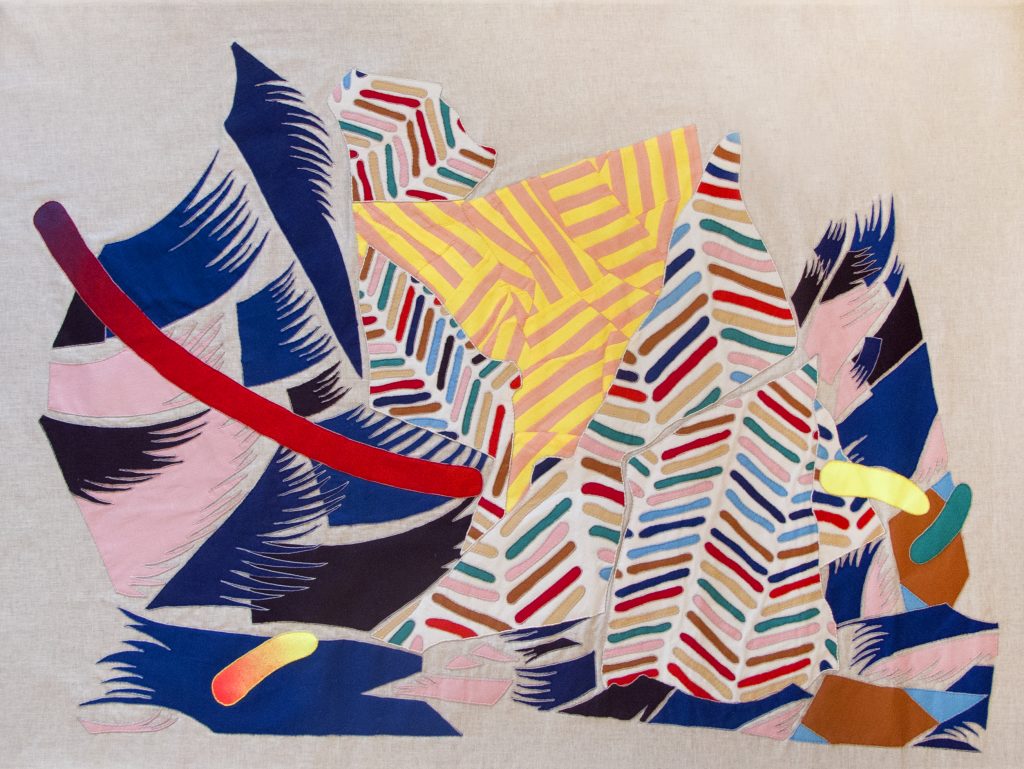
The exhibition is composed of three distinct parts organised around the unit "Ken" as a regulating trace (Painting / Memories; Sculpture / Shrine; and Textile / Inherited Skills). The Ken is a traditional Japanese unit of length, equivalent to six feet (shaku). Although nowadays it has almost been supplanted by the metric system, this unit is a common measure in Japanese architecture, where it is used as a unit of proportion. According to Nuria Mora herself, "I use Ken as a metaphor and allegory for a familiar term: Japanese bed. Our house was very big but there were also many of us. Although the door was always open for friends and exotic people who stuck their noses out of the green garden gate, there were no beds for everyone we invited to stay overnight, so we children always gave up our rooms and slept on mats on the floor. This is what my grandmother called a Japanese bed, synonymous with a party. The whole exhibition is organised around this module, the frames measure 195×97 cm. or proportional as well as the geometrical distribution in their arrangement in space is taken from the Japanese house. "The main piece in the exhibition is based on the stories by Gloria Fuertes illustrated by Maurice Sendak "Chicken soup with rice", which my grandmother used to read in bed in her bedroom", says the artist. A whole personal universe that translates into an intimate exhibition that takes into account even the smallest detail. "In this last piece, for example, the main colours of the painting are the upholstery of that room, with wide pink and white stripes. The choice of support also changes to linen because that is what the sheets were like and not paper as is usual in my work".
Nuria Mora (Madrid, 1974) began to paint in the street at the end of the 90s with her Fine Arts classmates, but she did so with a language of her own. Without any previous relationship with street art, Nuria Mora (Madrid, 1974) left aside the graffiti tradition until then based on names, characters and signatures to become, together with a young Eltono who came from France, SixeArt and Nano4814, the first group of urban artists to create geometric abstraction in public spaces. They called themselves Equipo Plástico. Since then, the artist has maintained a close relationship between her work, the city and architecture that has evolved into her own, absolutely recognisable language, which has led her to exhibit in some of the most important art centres in the world, such as the Tate Modern in London, the Joan Miró Foundation in Barcelona, the Place du Pilori space in Niort (France), the Pilar and Joan Miró Foundation in Mallorca and the Museum of Contemporary Art in Johannesburg.