Jazmin Donaldson
27 february 30 march 2021
MADRID
Desencanto
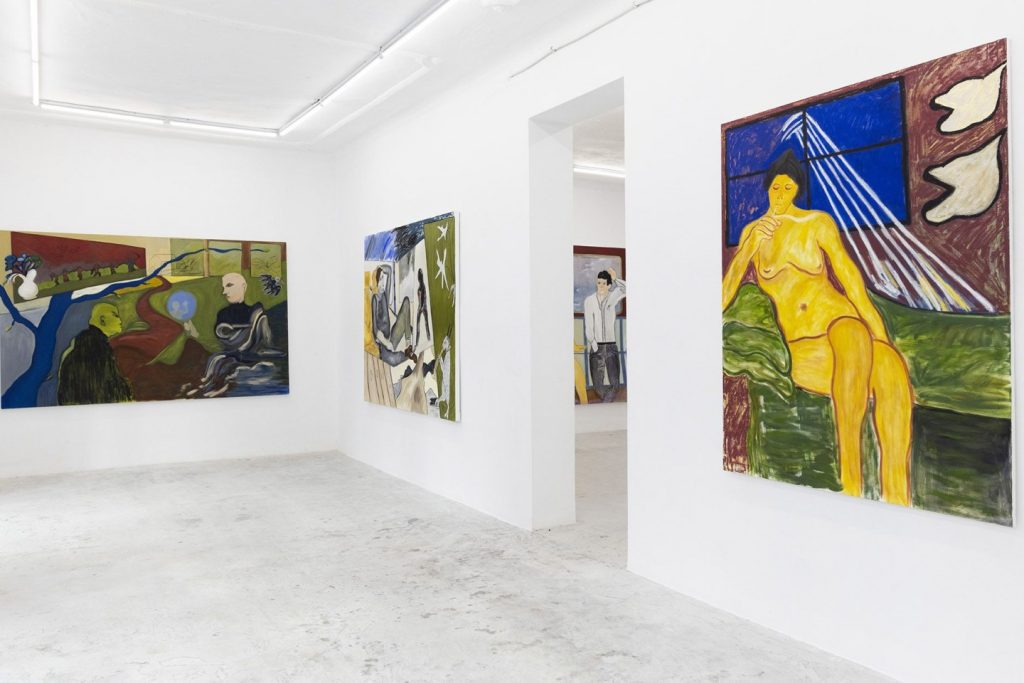
In her works Jazmin Donaldson (Buenos Aires, 1985) explores the power of painting to tell stories. The artwork is a theatrical piece, where there are characters and actions. The idea can come from the artist's own experience: an observation, a dialogue, a sound fragment, an image, a tactile reminiscence... or from the story of others. From this germ begins to sprout a complex pictorial universe, where known motifs from fables, myths and folk tales are re-signified to reflect on contemporary life.
Thus, hybrid figures, anthropomorphic animals and fantastic elements emerge that, through symbols and winks, invite the spectator to enter the game, to let himself be uncomfortable without fear or shame, to live his own adventure and extract any strand of meaning he finds in the rabbit hole. As in Alice's world, it is not about univocal conclusions or moralizing stories, but about entering a playful space that allows to suspend indoctrination and offer new possibilities and points of view. That is why Jazmin Donaldson's pieces abound in the absurd, the grotesque, the carnivalesque and the surreal: they are devices for questioning conventions and subverting roles, far from rationalism and conformism.
In an era where the superficial and glossy image abounds, merely decorative and anesthetic, subject only to the verdict of “I like it,” Jazmin Donaldson's narrative textures, loaded with dramaturgy, polysemy and ambivalence, provide an experience as different as it is necessary. There are monsters, beasts and dragons spewing fire, and many eyes want to avert their gaze and return to the garish screen. But the real violence is exercised by fixed molds, limiting preconceptions and discourses that reinforce oppression. The artist invites us to recognize this discomfort and to remain in it for a moment, not as an apology for suffering, but to open up the possibility of subversion and transformation.
In “Ya lo he escuchado todo, dijo Alicia”, we see a woman facing a fearsome dragon. Far from being frightened, she looks it in the face and defiantly shows it the middle finger of her hand. Perhaps the beast symbolizes her inner demons; or perhaps it represents the relentless harassment that women continue to suffer in order to act in certain ways and fulfill certain expectations: the struggle between social precepts and her intimate desires. She is surrounded by a protective aura, and the door in the background suggests the possibility of openness and escape. What will happen? We do not know. It is only a frame of a film that is projected on the viewer and which he now directs. In “To Enter or Not to Enter” the scene is a bit more playful but just as semantically rich. We see a tent that has a vulva as its entrance. Above is a woman with clownish features who winks at the spectator to encourage him to enter. The tent, as a protective space and shelter from the elements, alludes to sexual taboo and repression. The sacred and immaculate aspect of sex. The circus trait of the tent and of the woman, on the other hand, invite partying and excess, fantasy and role-playing. There is a tension between coming in or not coming in, which may also be the tension between sex for pleasure and coitus for reproduction (the English title, “To come or not to come inside”, is more suggestive). Be that as it may, a naughty, uncensored air prevails in the work, which helps to question prefabricated notions about what is expected of women. Neither in this nor in the rest of Jazmin's paintings: she is not the inspiring muse, nor an object of desire, nor a femme-fatale who seduces and threatens men. She is never reduced, but takes on different forms, personas and expressions, always active and defiant, autonomous, powerful, sexual and complex.
Today we experience everything with extreme immediacy. The proposal of this exhibition is to introduce the notion of time and invite us to reflect on the pause. Not only from the rich stories told by the works, which shake us from the media dullness of flat images (and which also allude to and arouse memories and fantasies, which always affect the experience of the present moment) but also from the pictorial language itself, full of textures, spaces without perspective and various juxtapositions, often in paintings executed on a real scale (“An empty promise”, for example, is three meters long). In other words, imposing, complex and fragmented works. Deep burrows. Transforming adventures.
Text: Josefina Insausti