Paula Valdeón Lemus
10 april 18 may 2021
MADRID
Otro azul
Architectures in sepia and memories in blue. Or vice versa.
By Juan Francisco Rueda
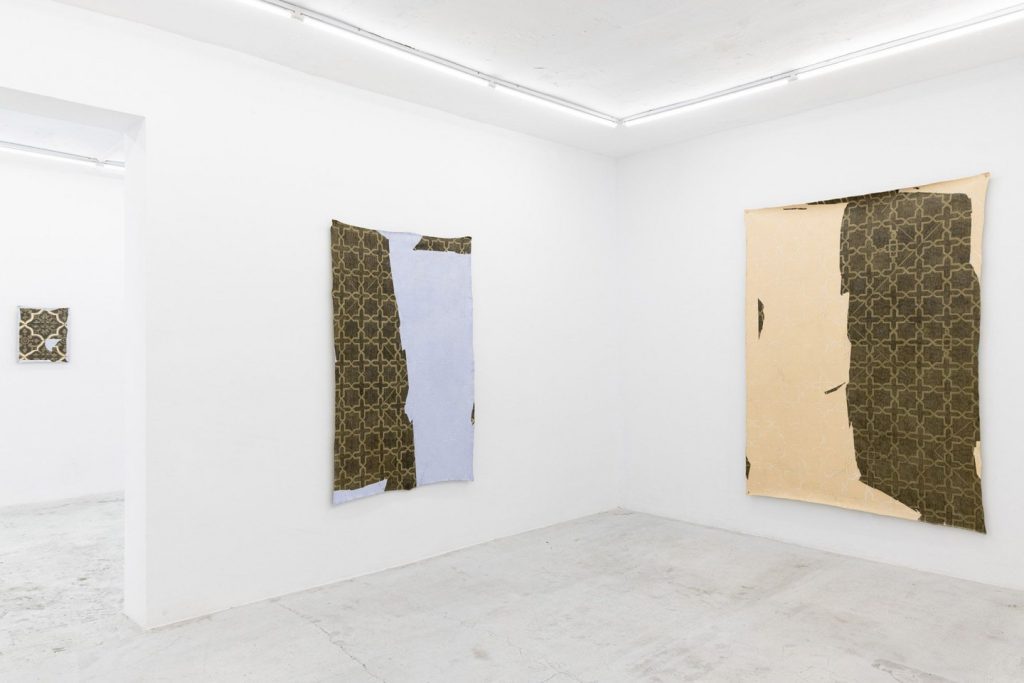
The work of Paula Valdeón Lemus can awaken in those who experience it the temptation to turn architecture into a metaphor of memory. From the outset, a certain architectural impulse can be perceived thanks to the references to tilework; to the overlapping fragments in dialogue that come together in her canvases, constructing them; to the interposition of geometric patterns obtained from railings or banisters, which condemns us to the role of someone who, from the other side of the border of the domestic (those lemens permeable to the eye), attends the interior splendor of the home; to the ceramic and textile nature (awnings) of some of his motifs, when not the very incorporation of these; or the arrangement of some of his pieces, assuming a certain condition of facade or three-dimensional structure, in which, as happens now in Another blue, copper rods or rods are added that recall the corrugated iron used for concrete reinforcement. In each of these options, Paula seems to formulate a synecdoche: to speak of architecture, the building or the home through one -of different, of many- of its parts.
But the allusion to the architecture and the nostalgia of a nature expelled from the metropolitan modus vivendi -core issues of her poetics-, fortunately materialize in her work through lyricism, evocation, delicacy, resignification and aesthetic redimension of the everyday, as well as a valuable integration of artistic disciplines (ceramics, drawing, painting, objet trouvé, installation or environment). Paula cushions these foundations of his work thanks to the invocation of memory, which also ends up becoming central to his poetics. Thus, we sense how much of those elements that participate in her works are still layers of time, which materialize through layers, glazes and certain evanescent invoice in some fragments of her drawings and paintings. Someone who works the layers of memory becomes an archaeologist. Paula uses a kind of weft or lattice that allows our view to slip through the openings and cracks. She finds these wefts in the geometric patterns that the material culture of the street offers her, such as store shutters, railings or railings. In her artistic process there is, therefore, a collecting work, a field work that also turns her into a flâneuse. Finding is essential in her practice and, for this, the artist has in drifting an essential procedure. Wandering to find, we could say. But for this, it is not enough to let herself go. Or to put it another way, without the artist's avid and curious gaze in the city, this drifting would become a mere misdirection.
This gaze, like Monet's in front of the façade of Rouen Cathedral, is what leads him to discover how the appearance of the whitewashed walls acquires the same hue, a similar tone, at different times of the day, specifically in the early morning and at sunset. The white acquires a tonality between magenta and orange, a chromatism that, by serendipity, had been obsessing the artist thanks to its appearance in different geometric motifs of tiles from the second half of the twentieth century that she transferred to her paintings. It is curious how this tonality is close to sepia, which has been the color linked to memories for generations prior to the digital era. This identical coloration of white according to apparently different atmospheric factors traps the artist. A response or sensation is born in her that would be between the revealing and what the surrealists called “the marvelous”, the poetization of reality and the revelation of something contained in the everyday, so that this condition was exceeded. Along with that orange, which we characterize as sepia because of the memory and experiential flow of her images, Paula uses blue as a color coprotagonist. This is an essential color of ceramics, present in the great schools and ceramic cores, as well as in the tilework and geometric motifs, the basis of the iconic universe of the artist. Blue takes on a special significance for her, marked by memory and by her experience in the restoration of mural painting - the architectural appears again as essential or base.
The architecture becomes a metaphor for memory thanks to the projection made by Paula through its dimension as a continuously inhabited space. The recreations of different tiles that we find on his canvases, superimposed as strata and visible precisely thanks to what we would call archaeological tastings, allow the notions of time and memory emerge as sepia images. Domestic architecture appears as a space crossed by memory, filled -and tiled- by layers of irreplaceable experiences and experiences, filled with biographical sediments -how many of us will not project moments of our lives linked to some of those ceramic patterns that, democratized or commercialized, occupied Spanish homes-, as well as a sacred space, eternal but renewed in the epidermal, in the coating.
"Otro azul" continues with the interest that Paula has been showing in previous projects about the incorporation and evocation of nature in the material culture and the imaginary of metropolitan societies. This evocation is done through stylization, the reformulation of natural elements according to patterns of the decorative arts and design at the service of industry, which offers it in serial products such as textile prints or tiles. In these ceramic baseboards, the image of the cosmos and of a paradisiacal and evasive nature that, like a mirage, acts as an oasis in the city, unfolds before the eyes of the urbanites who live in our homes. In them we find the stylization of a nature from which the human being has progressively moved away in the process of reaffirming his humanity and denying his animality. Therein lies one of the traumas of our species: the splitting of the natural, denying our primordial framework while building one of our own. Nostalgia and melancholy become traveling companions and engines that urge, through the decoration we incorporate into our lives, to recall the lost nature, that mythical Golden Age in which we lived in harmony with the natural order. This is essential or connatural to us. Paula poetically warns of this paradoxical situation in which we make present a stylized nature as a response to the expulsion of it from our lives.
In our relationship with the works of Paula we are caught in these layers and in the communion of disciplines that, from the graphics of drawing and painting, are directed to the three-dimensional, acquiring the nature of installation and environment. This implies a phenomenological response in us, forced to abandon a contemplative role to experience the installation in movement, as well as to spend time on it, something that would link with the fixed temporal strata. We are also caught in the balance between the filigree of the design, of that geometric pattern, and the large abstract stains like a tasting or chipping. Trapped, after all, in those architectures in sepia and memories in blue. Or vice versa.